
1 to 1 ABA Training
Our center’s one-on-one ABA (Applied Behavior Analysis) training covers a wide range of developmental areas, including speech and language, self-care, academic cognition, social skills, and play abilities. Through targeted interventions, we help children with behavioral challenges and attention difficulties make meaningful progress. Therapists begin with a comprehensive assessment and then create a personalized training plan tailored to each child’s needs.
A simulated classroom environment is set up based on a one-on-one teacher-child ratio. By mimicking the structure of a typical school day—including class transitions, scheduled lessons, and recess time—children learn how to participate in group activities, follow instructions, and adapt to school life with confidence.

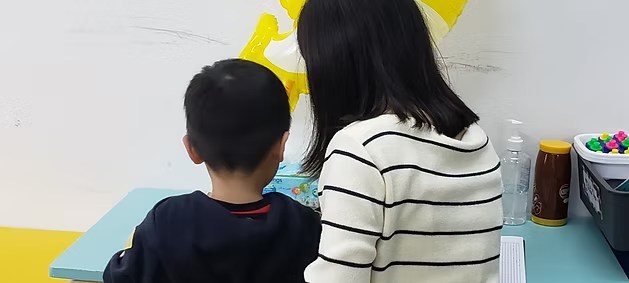
In one-on-one ABA training sessions, we focus to improve the child’s language, self-care, academic, attention training, social skills. Our goal is to foster well-rounded growth by providing targeted, individualized support tailored to each child’s unique needs.
1-on-1 ABA Center Training
At ABLE, our center-based ABA program supports holistic child development, focusing on generalization—helping children apply learned skills across settings and with different people. Whether they’re working one-on-one or in a group, at a table or on a carpet, our goal is to make learning meaningful and transferable to home, school, and community life.
We understand that transitions and new environments can be challenging, especially for children with special needs. That’s why we’ve created a safe, nurturing space where kids are gently supported in forming friendships, managing sensory distractions (loud noises etc), engaging in group activities, and learning key routines—like turn-taking, hand-raising, and interacting respectfully with others. Flexibility and self-regulation are central to our therapy, enabling children to grow in independence and emotional resilience.
The classroom is structured like a typical kindergarten, but maintains a 1:1 teacher-student ratio to provide personalized guidance. Children follow a daily schedule, transition between activities, and join group themes like art, PE, and academics—just as they would in a mainstream school.
Through this immersive experience, children learn to participate in group dynamics, observe and learn from peers, and thrive in social and academic settings. Our program equips them with not just classroom readiness, but life skills—empowering each child to grow with confidence, connection, and joy.
1-on-1 ABA Home Training
At ABLE, we understand that education commitments, transportation challenges, and everyday pressures can make it difficult for families to access center-based services. That’s why we offer ABA home training and family support—providing professional guidance and support directly in your home.
Home-based therapy helps children build essential skills in a familiar setting. Beyond social, academic, and communication development, children also learn daily living skills like hygiene, dressing, toileting, independent eating, and basic time management. Practicing these routines at home with parent involvement supports long-term independence.
The home also tends to elicit stronger behavioral responses, such as tantrums or destructive behavior, due to its comfort and familiarity. Our therapists are trained to manage these challenges in real time, offering corrective strategies and emotional support tailored to each child’s needs.
By integrating therapy into everyday life, families benefit from convenience, personalized care, and greater consistency. Parents can feel more at ease knowing that skill-building and behavior support are happening right where the child feels safest. At ABLE, we make therapy not only accessible—but effective, empowering families to support their child’s growth with confidence and compassion.
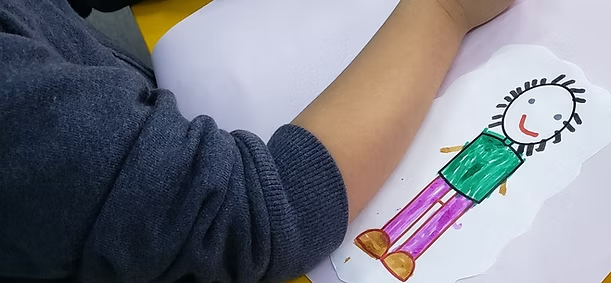
ABA home training offers families a unique opportunity to stay closely involved in their child’s growth and progress. It allows parents to observe daily improvements, gain insight into the therapeutic process, and better understand their child’s needs. Successful treatment depends on ongoing collaboration between caregivers and therapists—sharing observations, aligning goals, and making decisions together. With this strong partnership, behavior management becomes more consistent across settings, helping children meet developmental expectations with greater success and clarity.
Course Contents

Language skills
Focusing on the speech abilities of young children, we aim to cultivate their motivation to express themselves. Support is provided across various aspects—including single sounds, two-syllable combinations, articulation accuracy, and forming complete sentences. We can collaborate with speech therapists to speed up the process.


FAQ
ABA, short for Applied Behavior Analysis, is a therapeutic approach designed to improve learning abilities and behavioral challenges in children with special education needs. ABA therapy is currently one of the most widely recognized and effective treatments for autism spectrum disorder (ASD).
ABA training covers multiple developmental areas, including behavior management, language, social,self-care, academic, and play skills. By helping children acquire a variety of essential skills for learning and social interaction, ABA supports them in overcoming behavioral challenges and integrating more smoothly into everyday life.
Improving behavior management
Children with autism often face behavioral challenges such as emotional outbursts and impulsivity. ABA training uses Functional Behavior Analysis (FBA) to identify the root causes of problematic behaviors, and then teaches children appropriate replacement skills to address them effectively. ABA also emphasizes generalization—applying learned behaviors across different environments—ensuring that skills are practical and transferable to everyday life.
Improving language and communication skills
Children with autism often face challenges in language development—some may struggle to speak in full sentences, while others exhibit echolalia (repeating words or phrases). ABA therapy helps children develop communication skills by teaching speech step-by-step. Through reinforcement, prompting, and play-based learning, children improve vocabulary, express needs, and engage socially.
Improving social skills
Children with autism often lack the motivation to socialize. ABA introduces pretend play and role-playing activities to foster interest in social interaction, showing the benefits of collaboration—like completing tasks more efficiently with friends. Therapists then teach key skills such as expressing feelings, sharing toys, and taking turns, strengthening their social competence to navigate social situations more successfully.
Improving focus and attention
Many children with autism struggle with short attention spans and are easily distracted by the environment. ABA therapy nurtures learning-to-learn behaviors, including sitting still during lessons and sustaining attention on tasks. Gradually, children improve their concentration and learning efficiency.
Improving self care skills
elf-care can be especially difficult for children with autism due to motor co-ordination issues. Some may not yet be able to use the toilet, dress themselves, or eat independently by the age of three. ABA training boosts self-care skills in children with autism by breaking tasks into manageable steps and using positive reinforcement. Daily routines—like brushing teeth or dressing—are practiced consistently across settings. This helps to enhance confidence and independence.
Improving play skills
Children with autism often have weak play skills, sometimes repeating specific actions or focusing only on parts of toys. ABA training highlights collaboration, imitation, and imagination in play. Children engage in structured games like musical chairs, “Red Light, Green Light,” or “What Time Is It, Mr. Fox?”—helping them play with peers and integrate more easily into group settings
ABA training does not require children to have a formal diagnosis, making it accessible to a wide range of developmental profiles. However, it is most commonly applied to children with autism spectrum disorder (ASD), attention deficit hyperactivity disorder (ADHD), language delays, global developmental delays, other learning disabilities, and behavioral challenges such as aggression. As an early intervention strategy, ABA is most effective when introduced between the ages of 2 and 6, supporting children during their critical developmental years.
Research suggests that ABA therapy should be delivered intensively (20 to 40 hours per week) and customized to support comprehensive developmental goals. Before transitioning successfully into group settings, training must begin with a one-on-one therapist-to-child ratio. However, we also understand that such intensive therapy may not be easily achievable for children who attend school or participate in other extra-curricular activities. At ABLE, we offer flexible scheduling for families and children to ensure the best outcomes from their training experience.
We take pride in the transparency of our teaching process, made possible through our one-way mirror observation system. Caregivers can witness firsthand the creativity of our therapists and the joy children experience in every session. Our therapists are deeply passionate about teaching and genuinely love working with children—this authentic bond is what makes each child look forward to their time with us.
What truly sets us apart is our environment. First, our spacious center encourages movement and exploration, giving children the freedom to engage actively—unlike more rigid ABA models that often keep children confined to their seats. We nurture interaction and curiosity through play and meaningful peer engagement. Second, our setting is thoughtfully designed to mirror a real classroom, complete with a structured timetable that reflects a kindergarten routine. This not only strengthens 1:1 learning, but also allows children to apply their skills in small group settings—helping them build the confidence and adaptability needed for future classroom success.
ABA training is distinguished by its data-driven and highly structured approach. Therapists systematically collect and analyze behavioral data to tailor interventions, monitor progress, and refine goals—making measurable outcomes easier to observe. ABA sessions tend to be more intensive, often involving several hours per week of focused 1:1 training, where therapists actively build up skills with the child. In contrast, therapies such as speech or occupational therapy may occur less frequently and sometimes rely on caregivers to reinforce skills at home. This level of intensity and accountability gives ABA a unique edge in fostering long-term developmental growth.ors.
ABA training may be beneficial if your child shows delays in meeting developmental milestones, such as communication, social engagement, or self-care. Teachers might notice difficulties with focus, following instructions, or peer interactions at school, while pediatricians can help identify atypical behavioral patterns during regular check-ups. Your own observations are equally crucial—if certain behaviors, like repetitive actions or behavioral challenges, persist across different settings (home, school, outings), it may signal a deeper need for behavioral support. The next best step is to schedule a free consultation at our centre, where our clinical consultant will provide a thorough evaluation and professional guidance.

