Parent Information Area

Too many toys affect concentration

玩具

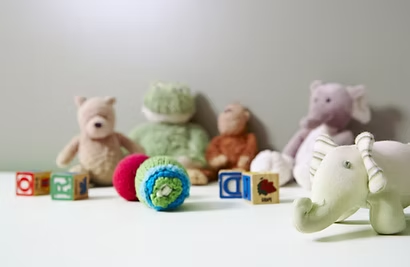
How many toys does your child have at home?
Do they play with a toy for 1 minute and then move on to another one?
Do they have little interest in the toys?
Or do they have a short attention span?

Focus is defined as the ability of a child to actively engage in a task and ignore the distractions of their environment (Fisher, Godwin & Seltman, 2014). For example, when they are playing with a toy car, the sound of a clock, other people talking, the background noise of a TV, or even the presence of other toys can distract them. Therefore, the environment setting is very important for children.

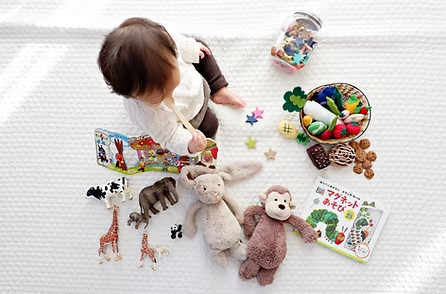
Toddler with toys

Research by Dauch and colleagues (2018) indicates that the fewer the number of toys, the higher the quality of play with the toys. When children were given only four toys, they played longer and more attentively on a single toy, explored and tried different ways of playing (e.g., making noise, stacking), and created more complex play (e.g., pretend play). When children were given 16 toys, they often switched quickly from toy to toy, and toy exploration was very superficial.

Based on this research and our observations of children, we can use the following six simple steps to effectively plan play areas to increase their focus, play, and motivation.

1. Limited number of toys

We can prepare 4 to 8 toys on the play area.

2. Various toys

There are a variety of toys to promote different types of toy play: educational toys (puzzles, books), dress-up toys (figurines, costumes), action toys (blocks, Legos), manipulatives (cars, toys with buttons, etc.).

3. Observation

Observe which toy your child plays with longer or shows interest in (smiling, looking relaxed).

​Put half of these preferred toys on a shelf/in a box so they can still see it and out of reach.

This also promotes speech skills and teaches children to say: ‘I want to play with ____’, ‘Can you help me?’

4. Effectively plan the play area

The other half’s go-to toys are placed on the bottom shelf so that the child can play with them anytime, anywhere.

5. Mix

Mix in some less interesting toys on lower shelves so your child has a chance to play with them, too.

6. Switch and repeat

Toys on the top and bottom shelves need to be switched out every three to four days, which is plenty of time for kids to explore and keep the toys fresh!

Refer to:

Dauch, C., Imwalle, M., Ocasio, B., & Metz, A. E. (2018). The influence of the number of toys in the environment on toddlers’ play. Infant Behavior and Development, 50, 78-87.

Fisher, A. V., Godwin, K. E., & Seltman, H. (2014). Visual environment, attention allocation, and learning in young children: When too much of a good thing may be bad. Psychological science, 25(7), 1362-1370.

Leave a Reply