

ABLE Featured Articles
The 6-Month ABA Therapy Plateau: Is Progress Stalled or Transforming?

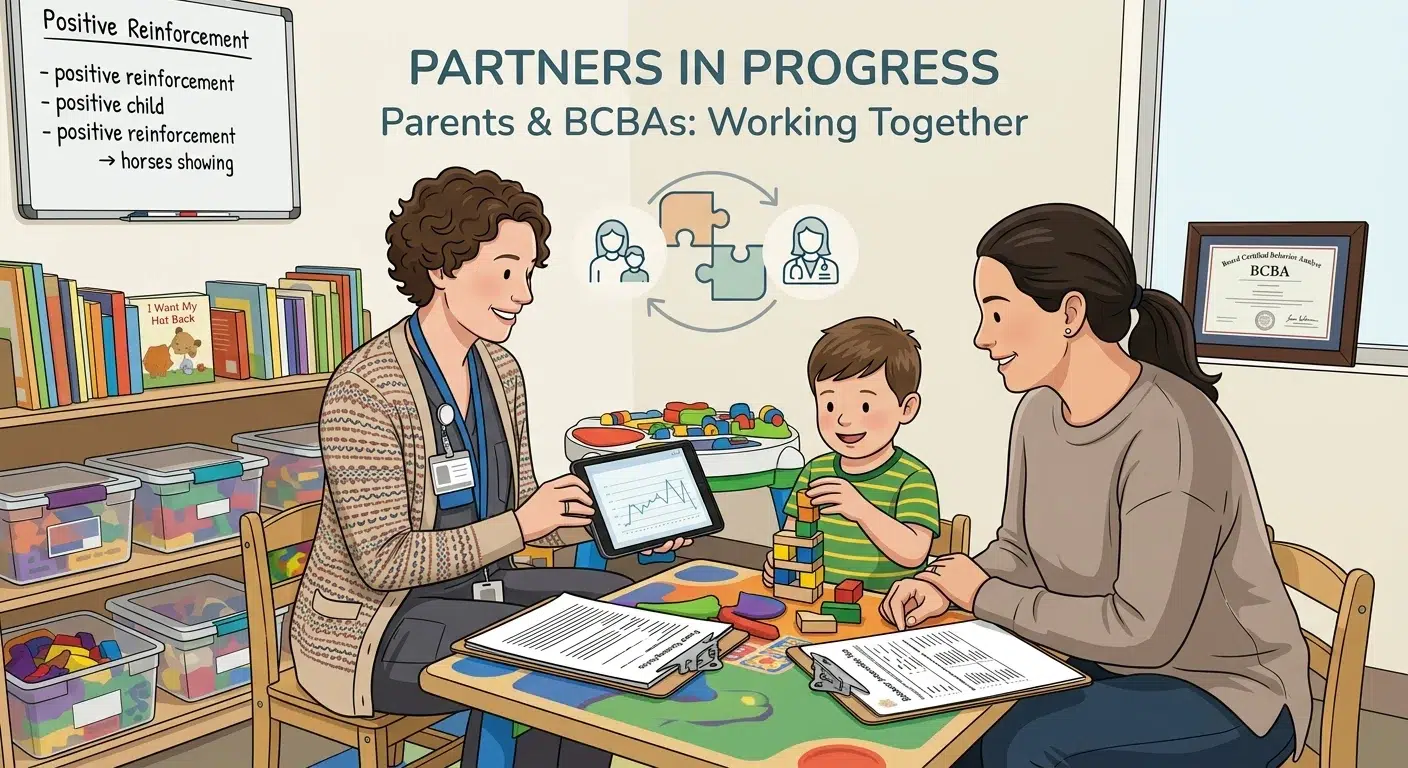
“In the first two months of ABA therapy, my child made incredible leaps! The tantrums stopped, and we saw instant changes. But now that we’re around the 6-month mark, progress seems to have hit a wall. He’s doing the same programs every week. Is he stuck? Has ABA stopped working?”
As a BCBA, this is one of the most common conversations I have with parents. This feeling is completely understandable and so common, in fact, that it leads some families to consider pausing or opting out of services altogether.
If you are a parent sitting with those exact thoughts,I want to share something from the heart of my clinical practice: your child has not stopped making progress but the illusion of stagnation.
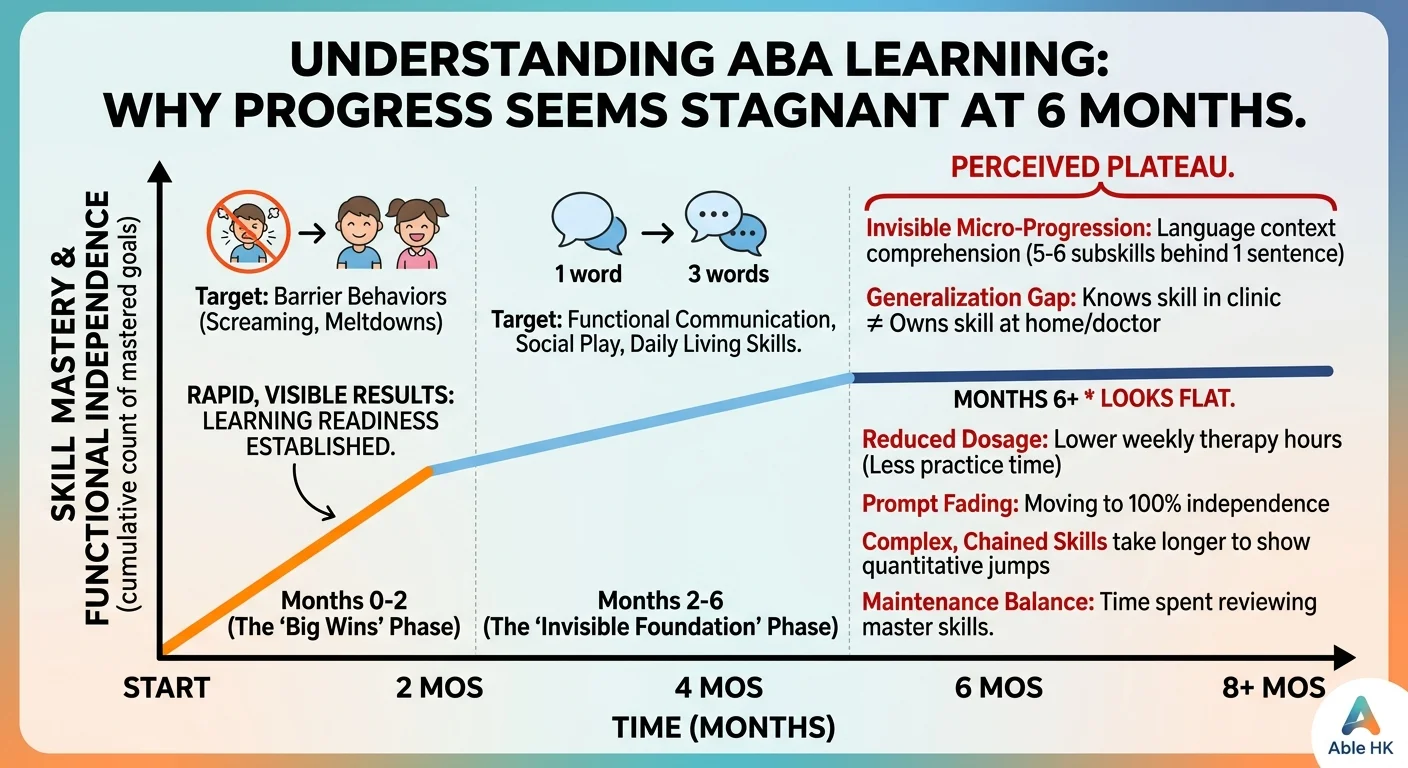
Months 1–2: The “Big Win” Phase (Learning Readiness & Visible Behaviors)
During the first 60 days of Applied Behavior Analysis (ABA) intervention, therapy heavily prioritizes learning readiness and addressing barrier behaviors.
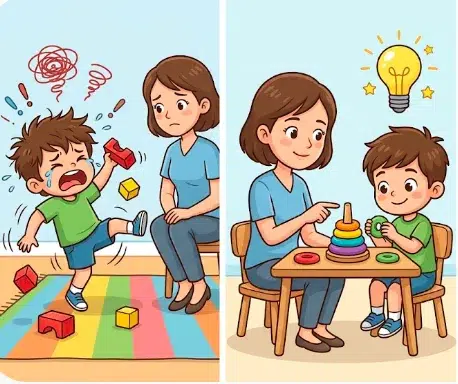
If a child frequently engages in screaming, kicking, biting, or intense tantrums when demands are presented, learning higher-level cognitive or language skills is nearly impossible. Behavior analysts immediately target these high-intensity behaviors by teaching basic tolerance, establishing learning readiness, and creating learning motivation.
- Why it feels so fast: Reductions in disruptive behaviors are glaringly obvious. Going from five daily screaming episodes to zero in a matter of weeks transforms household stress immediately. To a parent’s eyes, this represents a massive, highly visible victory.
Months 3–6: The “Invisible Foundation” Phase (Subtle & Intrinsic Replacement Behaviors)
Once the barrier behaviors subside, the core focus of ABA programming transitions to building replacement behaviors and functional communication. This is where progress appears to slow down, even though cognitive work has actually intensified.
Instead of eliminating an obvious behavior (like stopping a tantrum), therapists are now constructing nuanced skills—such as expanding vocabulary, initiating social play, or expressing internal states.
- Emerging vs. Mastered Language: Consider a child expanding their functional language. Moving from 2-word utterances (“want milk”) to 3-word combinations (“want cold milk”) does not happen overnight. A child will use 3-word phrases intermittently long before doing so consistently. Because this milestone emerges subtly, parents often miss these micro-progressions during daily routines.
- The “Home vs. Clinic” Context Gap: In a 1-on-1 ABA session, the therapist purposefully engineers 40 to 60 communication opportunities per hour—placing favorite toys out of reach, setting up turn-taking games, and holding back items until requested. At home, parents naturally anticipate their child’s needs out of love, or engage in relaxed parallel play where high verbal demands aren’t imposed.
- Therapy & School Fatigue: After navigating a full day of school followed by intensive therapy, children naturally need downtime. Being quieter or less talkative at home in the evening is often just a sign of energy depletion, not lost skills.

To show you what this invisible work looks like, let me share a story about a 5-year-old boy I worked with named Lucas.
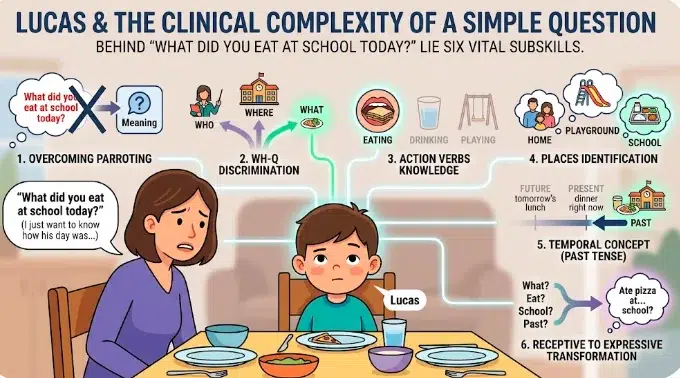
His mother came to me with a simple, heartbreaking request: “I just want to sit at the dinner table and ask him how his day was. I ask him I thought was a very simple question, ‘What did you eat at school today?’ and he either stares at me or just repeats the question back to me.”
To a parent, “What did you eat at school today?” is a simple, affectionate question. But clinically, answering that single question requires a child to coordinate at least six distinct subskills simultaneously across receptive and expressive domains:overcoming parroting, Wh-q discrimination (What vs Who etc), knowledge on action verbs (eat vs drink vs play), places identification (school vs home vs playground), temporal concept (past tense).
So while this seemed like a very simple question to answer, to a clinician and Lucas, he must master all of these subskills before he can flexibly provide a response. Hence this takes time!
Other factors that play into the ‘slowed’ progress:
A)The Generalization Gap: Knowing a Skill vs. Owning a Skill
Another major reason progress seems stagnant at month six is the time required for generalization.
Parents often assume that once a child answers a question correctly in the therapy room, the skill is mastered. However, true functional mastery requires answering that same question across different people, phrasing, and real-world environments.
| Skill Stage | Clinical Target | Real-World Application | Why Progress Appears Stagnant |
| Initial Acquisition | Answering “What is your name?” with a familiar therapist in a quiet room. | Child says “John Smith” when prompted by therapist. | The skill is acquired under restricted conditions. |
| Generalization & Expansion | Answering “What’s your full name?” or “What do people call you?” at the doctor’s office or school. | Child freezes when asked by a nurse: “Can you tell me your preferred name?” | Parents see the child freeze and assume they didn’t learn the skill, unaware of the cognitive jump required to generalize across phrasings and strangers. |
Building generalized response sets takes weeks of systematic practice. While the program name on paper might look identical for months, the underlying criteria are shifting from prompted responses in clinic to spontaneous responses in community settings.
B. The Prompt-Fading Curve (Moving from Assisted to Independent)
Going from requiring physical guidance to answering with a verbal prompt takes a few sessions. But fading that final verbal prompt to achieve 100% independent initiation takes significant repetitions. To an outside observer, the child appears to be doing the “same task” for weeks, but behind the scenes, prompt dependency is systematically being dismantled.
C. Shifting from Single-Step to Chained/Complex Skills
Early targets are often single-step behaviors (e.g., matching shapes or pointing to flashcards). Mid-stage ABA targets complex, multi-step chains—such as flexible problem-solving, peer turn-taking, executive functioning, and emotional self-regulation during frustration. Complex skills naturally take longer to show quantitative jumps.
D. The Communication Drop-Off
When ABA therapy begins, communication between parents, BCBAs, and ABA therapists are at an all-time high. There are lengthy intake debriefs, daily goal reviews, and frequent check-ins as trust is established.
As therapy routines settle in over 3 to 6 months, daily debriefs naturally become briefer and more streamlined. Without realizing it, this reduction in formal communication can leave parents feeling out of the loop regarding the subtle micro-goals their child is mastering each week.
E. The change in session frequency.
Initially, parents want client to settle into the ABA program quickly and may start intensive 5 day program. But as the months roll on, parents may start to reduce hours due to financial constraints, scheduling and school demands, therapy burnout (child attends ST,OT,PT, interest classes with ABA).
- At 15 hours a week, the child achieves a target e.g. 300 trials in 2 to 3 weeks.
- At 6 hours a week, achieving those same 300 trials takes 6 to 8 weeks on the calendar.
The child’s underlying learning speed per hour hasn’t slowed down at all. But because total weekly practice hours have been halved, mastering the exact same target takes twice as many calendar weeks.
Moving forward: Parents & BCBAs need to work together
If you ever feel your child’s progress has plateaued, do not give up on therapy—re-engage with your clinical team. Here is how we proactively tackle the illusion of stagnation at our centre, and how parents and BCBAs can partner together:
- Daily Data Monitoring & Proactive Troubleshooting: Clinical progress in ABA is entirely data-driven. Our supervisors check every child’s IEP program data daily to ensure steady upward trends and immediately troubleshoot any specific goals that show signs of stalling before they turn into real bottlenecks.
- Live Observations & Visual Data Reviews: At our centre, we host regular IEP meetings paired with live therapy observations. Our supervisors walk you through session dynamics in real time while visually explaining the underlying skill graphs. We also use the 6-month milestone as a designated checkpoint to re-examine treatment goals, update target behaviors, and recalibrate expectations for the next phase of development.
- Weekly Mastered Skill Updates for Home Generalization: Every week, our therapists provide parents with an updated list of newly mastered goals. This gives you a clear, simple guide on which skills your child is ready to practice naturally during daily home routines—without requiring complex preparation or formal teaching.
- Structured End-of-Session Debriefs: Communication is a two-way street. After each session, our therapists provide a structured hand-off update so you can ask questions, share your own observations from home, and stay aligned on weekly targets.
The Bottom Line: Real developmental growth isn’t always a dramatic breakthrough. More often, it is the quiet, methodical consolidation of subtle foundational skills that prepare your child for lifelong independence.
ABA therapy progress rarely stagnates at any stage—rather, it is usually the context, practice frequency, or communication that shifts. When parents and clinical teams stay closely aligned, every phase of therapy reveals meaningful growth

