

ABLE Featured Articles
How to Prepare a Child with SEN for new school year: 7 Practical ABA Strategies for Back-to-School

Well done to all parents for working so hard to keep your children engaged and learning over the break! As a Board Certified Behavior Analyst (BCBA), late summer is always my busiest season. Parents frequently reach out asking how to ease the sudden shift from unstructured summer days to the high-demand environment of a new school year—especially when transitioning into major milestones like kindergarten, Grade 1, or moving to a brand-new campus.
Transitions often trigger anxiety, emotional outbursts, or task avoidance when environments feel unpredictable or when demands outpace a child’s current readiness skills. From an Applied Behavior Analysis (ABA) perspective, our goal isn’t just to tell children what is coming—it is to prime them, break down complex routines into achievable steps, and build their independence through structured, positive practice.
Whether your child is entering a new school or moving up a grade, here are seven proactive, ABA-grounded strategies to prepare them for a smooth and confident start.
1. Tune Sleep Schedules
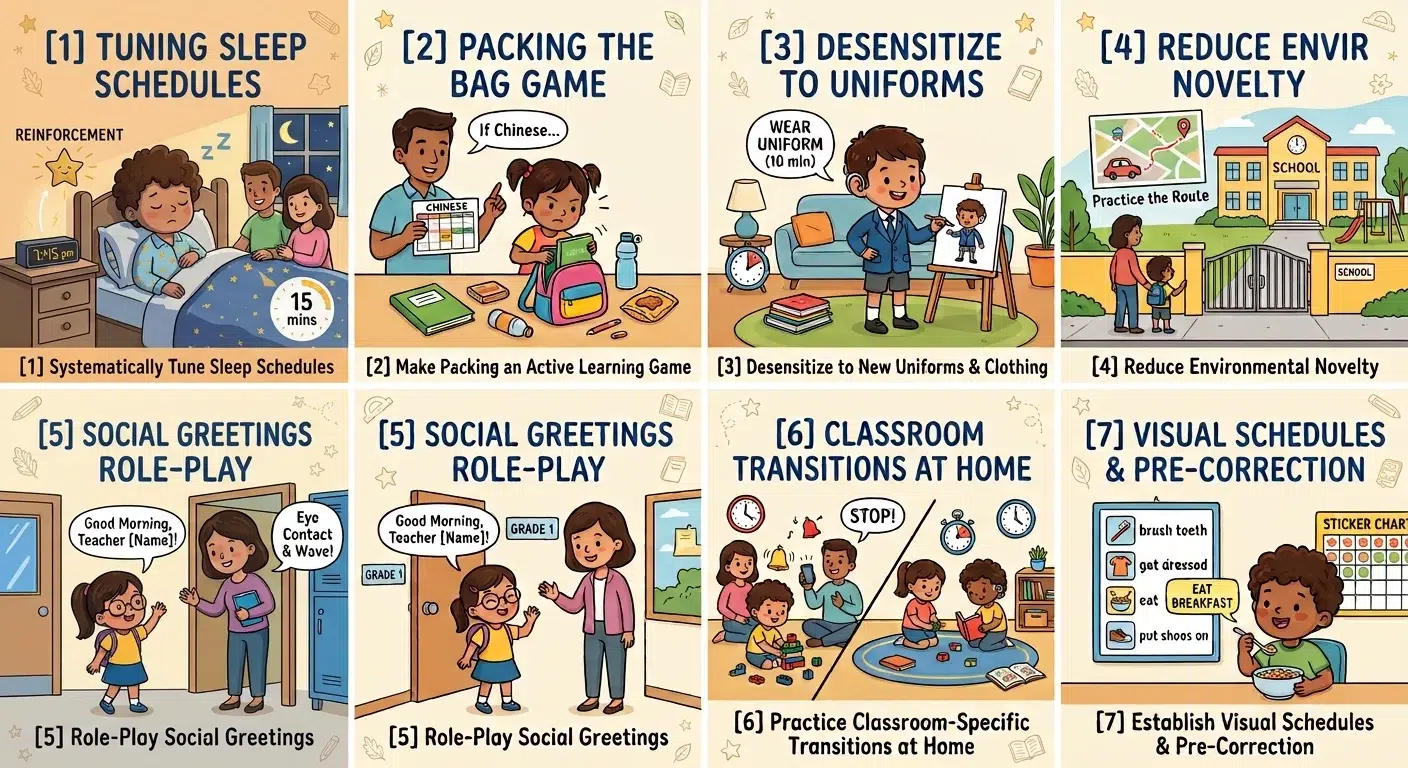
The first thing I ask parents is: “How is your child sleeping?” In clinical practice, we frequently see children who arrive at the center or school fast asleep in their strollers. When a child sleeps through their travel, they miss vital opportunities to participate in morning routines—like eating breakfast or waking up fully—and often feel disoriented when transitioning directly from sleep to seeing their teacher. A sudden schedule shift on Day 1 (such as waking up two hours earlier) creates severe physical fatigue, significantly lowering a child’s frustration tolerance and increasing morning resistance.
- Strategy:Adjust early. Rather than making a sudden change, adjust bedtime and wake times gradually 10 to 14 days before school starts.
- How to Implement: Shift sleep and wake times by 15 minutes every 2–3 days. If summer wake time was 8:30 AM and school wake time is 7:00 AM, move wake-up to 8:15 AM for two days, then 8:00 AM, and so on. Pair these earlier wake-ups with a high-preference morning activity (like a favorite breakfast or brief playtime) so waking up early is immediately reinforced.
2. Make Packing the Bag an Active Learning Game
Another common challenge is that children often don’t know what items they own, what they need, or where their belongings are because parents or caregivers pack for them. Even a 2-year-old can begin taking responsibility for identifying and checking daily essentials like water bottles and snack boxes. Instead of packing your child’s bag for them, turn morning preparation into an interactive exercise. This builds executive functioning skills, fosters functional independence, and helps children associate specific items with specific daily routines.
- Strategy:Make it into a interactive game
- What we can do
Sit down with your child and their weekly timetable. Ask conditional, prompt-based questions:
“If you have Chinese lesson tomorrow, what materials should you take?” - Encourage your child to search through their study space, locate the exact items—such as their Chinese workbook and textbook—and place them into their school bag independently. Always offer immediate descriptive praise when they succeed: “Great job finding your Chinese workbook and zipping it into the main pocket!”

3. Desensitize to New Uniforms & Clothing
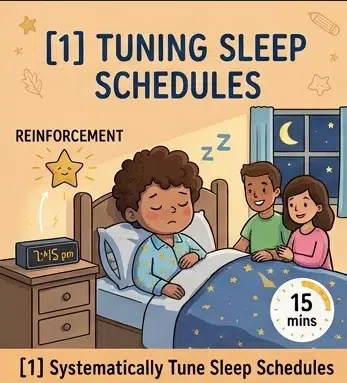
A lot of SEN children are very particular with how they dress, and what they wear. Many children experience sensory processing sensitivities, making rigid school uniforms, stiff collars, tight waistbands, or new shoes overwhelming. I even worked with a child at school who had severe tantrums every single week during art class—not because he disliked painting, but because he couldn’t stand required art apron against his skin.Expecting a child to tolerate a brand-new outfit for 6 to 8 hours on Day 1 often leads to sensory overload and early-morning meltdowns.
Strategy:gradual exposure beforehand
- Start Days Ahead: Have your child try on their full uniform 7 to 10 days before school starts—never wait for the first morning.
- Gradual Exposure: Have them wear the uniform for just 10–15 minutes while engaged in a fun, highly preferred activity (like drawing or playing a board game) to associate the clothing with positive experiences.
- Increase Duration: Gradually extend the time each day (15 mins-> 30 mins -> 1 hour).
- Troubleshoot Sensory Triggers Early: Use this practice time to identify issues—cut off tags, choose seamless socks, wash stiff fabrics multiple times with fabric softener, and break in new shoes around the house.
4. Reduce Environmental Novelty (Visual Priming)
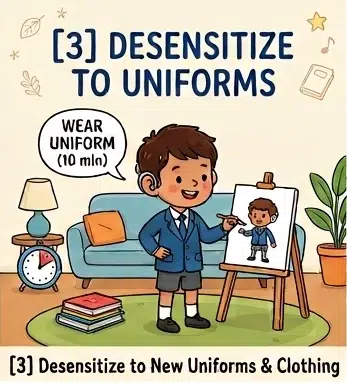
Over the years, I’ve observed that many first-day meltdowns aren’t about schoolwork at all—they are triggered by sheer uncertainty. Parents often report their child refusing to go inside, needing mum to carry him physically in. In a new school, when a child doesn’t know where the bathroom is, what the main entrance looks like, or where their desk will be, their baseline anxiety skyrockets before they even step inside. Visiting the actual physical setting beforehand strips away that terrifying mystery and makes the surroundings feel predictable and safe. Visiting the physical environment beforehand reduces novelty and makes the surroundings predictable.
- Strategy: make trips to familiarise child with the route and what they can expect
- How to Implement:
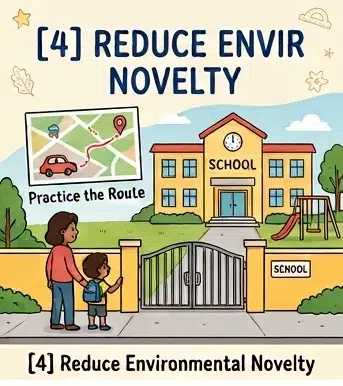
- Practice the Route: Drive or walk the school route at the exact time you will travel on school mornings. Point out key landmarks along the way (“There is the bus stop,” “Here is where we turn left for school”).
- Visit School Grounds: Walk around the school perimeter, locate the playground, and point out the main entrance doors.
- Explore Website Photos: Open the school website together and browse pictures of the main lobby, hall, playground, and classrooms. Connect positive thoughts to what they see (“Look at those big art tables! That’s where you’ll get to paint.”).
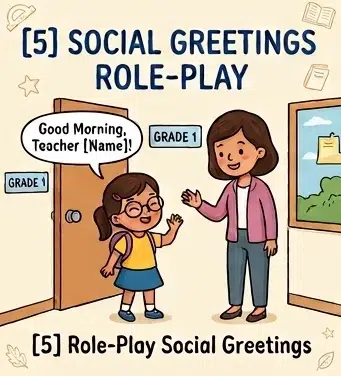
5. Role-Play Social Greetings
When I shadow children during their first week at a new school, one of the biggest hurdles I notice is the sudden social demand from unfamiliar faces. Well-meaning teachers and peers will walk up and say hi, and often I see SEN children freeze, hide behind their parents, or walk away simply because they don’t know what script to use. Entering kindergarten/grade 1 or moving to a new classroom requires novel social interactions. Rehearsing basic, predictable responses at home gives them a ready-to-use blueprint so they don’t feel put on the spot.
- Strategy:Roleplay and practise at home with parents or with figurines
- How to Implement:
- Teacher Greetings: Rehearse eye contact, a warm wave, and saying: “Good morning, Teacher [Name]!” Practice while standing at a doorway to simulate entering the classroom.
- Peer Self-Introductions: Practice a simple script: “Hi, my name is [Child’s Name]. I’m in Grade 1. What’s your name?”
- Keep practice sessions short (3–5 minutes), lighthearted, and playful. Take turns playing the teacher or classmate.
6. Practice Classroom-Specific Transitions at Home
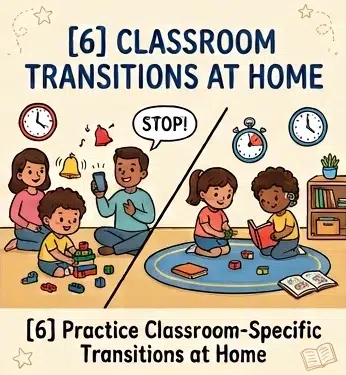
In clinical practice, transition difficulties are by far the most common goal parents and teachers ask me to work on. I frequently observe children in classrooms having major meltdowns simply because a fun activity ended without warning, or because the loud transition bell rang while they were mid-task. During my school visits, I once saw a student cry uncontrollably or lying on the floor every time the class moved from the carpet to their desks—not because he hated table work, but because he couldn’t process the sudden shift in expectations. Teaching children to respond to specific environmental cues (like bells, timers, or visual signals) at home removes the shock factor when those same signals occur in a busy classroom.
- Strategy: Following a time table or game to listen in to certain sounds.
- How to Implement:
- Simulate School Signals: Practice responding to auditory signals at home. Play a school bell chime on your phone and teach the clear rule: When the bell rings, hands stop, eyes look up, and it’s time to tidy up.
- Practice Activity Shifts: Rehearse moving between structured stations (“When the timer goes off, we move from circle time on the mat to the reading corner”).
- Reinforce Smooth Transitions: Offer immediate praise or stickers when your child shifts activities smoothly without delay or protest.
7. Establish Visual Schedules & Pre-Correction
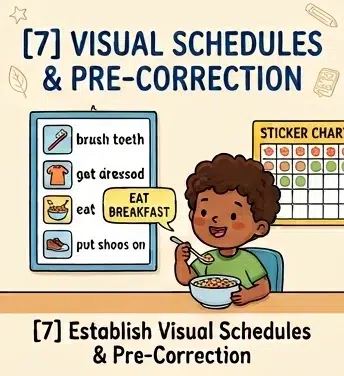
I often see parents fall into what I call the “verbal reminder loop”—repeating “Get your shoes on,” “Brush your teeth,” “Pick up your bag” five or six times every single morning. In my experience, this constant stream of verbal nagging actually increases child frustration and delays the process because the child learns to rely entirely on parental prompts instead of building independence. Parents often report mornings are the most stressed for both parents and children due to the time constraint. We’ve taught children to use a simple visual checklist board. The moment the child could visually see what step came next, the morning arguments vanished almost overnight.
- Strategy: Visual checklists
- How to Implement:
- Post a simple step-by-step visual checklist at eye level: Brush Teeth ->get Dressed -> Eat Breakfast -> Pack School Bag->Put Shoes On.
- Review expectations before starting the morning routine: “Before we start breakfast, let’s look at our checklist. What is step 1?”
- Can set a time limit and big reward at end of the week if all done correctly and accurately
Parent Strategy Summary
Preparing for a new school year isn’t about removing every single butterfly from your child’s stomach. Anxiety around new environments, teachers, and expectations is entirely normal.
Instead, early behavioral preparation is about giving your child predictability, familiarity, and a sense of mastery over their daily routines. By breaking down big expectations into small, manageable steps weeks before Day 1, you help build their learning confidence, independence, and joy in going to school.
📝 Frequently Asked Questions (FAQ)
It is best to start 10 to 14 days before the first day of school. This gives enough time to fade sleep schedules gradually, practice wearing uniforms, and rehearse morning routines without feeling rushed.
Avoid forcing them to wear it for long periods right away. Start small by having them wear just the uniform shirt or shorts for 10 minutes while engaged in a favorite activity (like watching a show or building Lego). Gradually increase the duration each day and check for sensory irritants like tags, tight elastic, or stiff collars.
Use visual priming. Drive or walk past the school multiple times, explore the playground perimeter, and browse photos on the school’s website together. Knowing what the building, entrance, and classrooms look like drastically reduces first-day environmental anxiety.
Start practicing classroom-specific signals at home using timers and bell sounds. Rehearse moving from a preferred activity to a non-preferred activity (e.g., stopping play when the bell rings to tidy up) and provide immediate reinforcement when they transition smoothly.
'/%3E%3C/svg%3E)
'/%3E%3Cuse%20href='%23a'%20transform='rotate(216%20450%20300)'/%3E%3C/g%3E%3Cuse%20href='%23b'%20transform='rotate(72%20450%20300)'/%3E%3C/svg%3E)